Wednesday, March 19, 2014

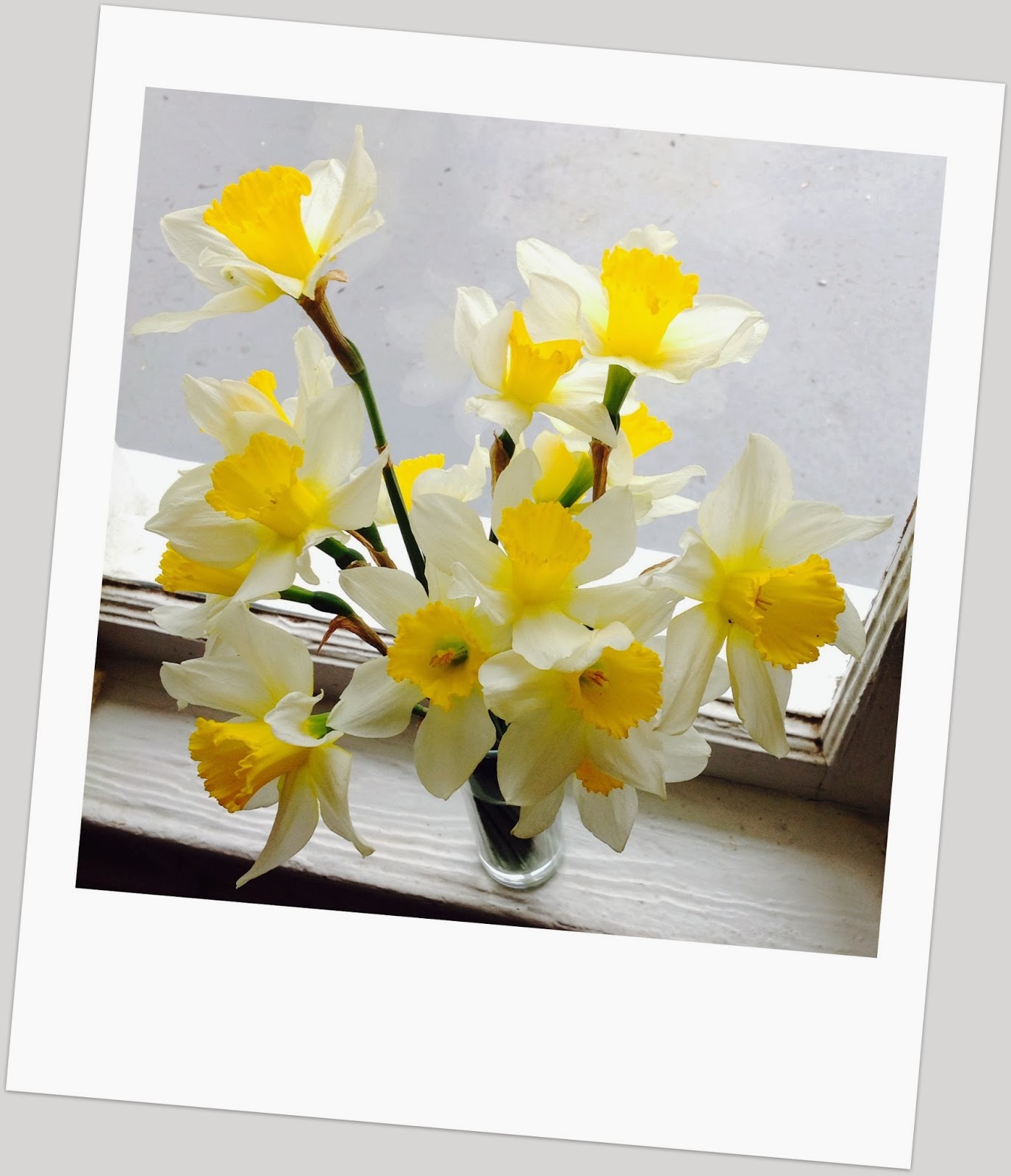
daffodils to chase the dark away...


“There is some kind of a sweet innocence in being human  - in not having to be just happy or just sad - in the nature of being able to be both broken and whole, at the same time.” C. Joybell C.

This is a difficult time of year for me. The fun and festivity of the holidays is long gone and spring seems far away. The brief bright days we get now and then only tantalize, and accentuate how bleak, cold and dreary the gray days are. I feel cold, bone cold; it’s hard to muster a positive mood or a good attitude. I know I am well blessed and I’m thankful for that, in a quiet, gloomy sort of way – think Eeyore in Winnie the Pooh and you have me on a March day.

I’ve struggled through late winter and early spring for years. For a while I thought it was depression, but the fact that it always goes away once the days become consistently warm tells me I suffer from something more temporary. Being S.A.D. as in having Seasonal Affect Disorder makes more sense. This is a state brought on by a shortage of Vitamin D, which is caused by too little time in the sun.  

The suggested remedies for S.A.D. include spending time near a box lit with natural light, replacing regular light bulbs with all-spectrum ones, taking Vitamin D supplements and spending more time in the sparse late winter sun. If these things fail (and I find they do) seeing a therapist, taking antidepressant drugs and/or going on a cruise are next on the potential cure list. In lieu of doing any of those things, I pick daffodils, almost daily. Their cheery bright yellowness lessons my gloom and I feel warm when I look at them.  

Daffodils bloom all over Barrow County and as I pick them, I wonder how they got to the places where they grow. Daffodils aren’t native and don’t grow naturally; someone had to plant them. Who, when and why? So many untold stories in those bouquets of light, growing in such abundance along the roadside, in abandoned lots and in fields where oblivious animals graze.
 
Before I discovered daffodils during these S.A.D. days, I wrestled fiercely with my depression. I alternated fighting and trying to conquer it, with applying reason in an effort to will it away. Nothing worked; my S.A.D. got bigger and bleaker every year.
 
Then I discovered The Black Dog. William Styron, the author, called his depression “The Black Dog.” That was his way of naming it, putting a face on it and coming up with a way to coexist with it. I liked that idea and so the next time my own Black Dog came around, silently slinking his way onto the porch of my S.A.D. mind, I let him in, gave him a name and eventually adopted him. This seems to be just what he was waiting for because since we’ve come up with this arrangement he’s much gentler with me.
 
My Black Dog usually shows up in mid-to-late January. Occasionally, he appears later - a few times so much later that I thought he’d found someone else’s S.A.D. door to darken. But no, there he came, never to be forgotten, as predictable as the blooming of those daffodils.     
 
It may be surprising that one can develop a consistent and respectful relationship with one’s depression, but over the years my Black Dog and I have forged just that. He lets me work, and feed the bright red cardinals in my yard, and gather daffodils by the side of the road. And, I let him stay, ever present, on the couch near my computer desk, in the back seat of the car, at my feet in the kitchen, on a rug near the fire.
 
Our relationship is not a forced one; we know our time together is temporary. I accept The Black Dog and he stays in his place. There was a time when he’d try to take control, but as I became more comfortable with his visits – remembering they are always finite – he became a less pushy and manipulative guest. Now we simply coexist, knowing that as soon as April comes and the dogwoods bloom, my Black Dog will lope off, to return only when the cold winds kick up again. 

If you’ve known the privilege of having an old (real) dog as a companion, you’ve seen the determination and optimism with which dogs deal with aging, aches and pains. They face this adversity with a consistency equal to the brightness of those daffodils. No matter how tired and sore they become, they greet each day with hope and the obvious will to continue on. 

Maybe this is why I have accepted my Black Dog as the companion that he’s become. Learning to accept and coexist with him has helped me see that I, too, can face adversity with consistency, determination and optimism.

And, so here my Black Dog lies, always near, keeping his dark vigil until spring and its message of hope return. Some nights, when the wind is whipping fiercely or the sky is particularly dark, I am comforted by the sound of his tail thump thumping at the foot of my bed. Just like those daffodils, he soothes my sad heart and I fall back to sleep listening to the soft sound of his breathing, knowing that he’s dreaming of the adventures he’ll have, once he leaves my side once more.  


Wednesday, March 12, 2014

sorting through...letting go...


Is willing to accept that she creates her own reality except for some of the parts where she can’t help but wonder what the hell she was thinking. – Brian Andreas and the StoryPeople
 
I spent the past two days cleaning out a storage room I’ve done nothing but add things to for the past 23 years. What a mess! I knew I had hoarding tendencies and an over emotional attachment to the past, but this was ridiculous.
 
I seem to have saved every toy my kids ever played with, nearly every drawing either of them did, plus most of the stories or writing they penned. I also saved every greeting card I’ve ever received, a collection of old costumes for all ages (now ruined by squirrels and mice), a few magazines, and a box of beach things – kites, squirt guns, pool floaties, water noodles and such - that, judging from the condition they’re in, are from about the mid-90’s. We’ve been to the beach since then, but didn’t use any of this stuff. Apparently, I just put it all away and forgot about it. 
 
Holiday decorations? Oh, yes, I saved plenty of those. Most were only used a few times, then packed away and forgotten, left to disintegrate slowly, with gnawed off pieces adding a festive touch to mouse and squirrel nests along the way.
 
Old school notebooks, my kids’ high school classwork, most of their report cards – beginning with pre-school – were also all dumped into plastic bins and stashed away. I even found a small metal trunk full of my high school things - notebooks, school work, report cards, diaries and other long forgotten and no longer remotely relevant objects.  
 
Since I come from a family of hoarders and people with an over emotional attachment to the past, some of this is not a surprise. I did sigh a long sigh of dismay, however, when I found several boxes of things my family saved from long, long ago and handed off to me. I’ve never even opened these boxes and I’ve been toting them around with me for the past 30 years. Why? Because a scrap book containing every “Congratuations!” card my parents received at their wedding or a box of “It’s a Girl!” well wishes sent when I was born are of interest to anyone anymore? My parents are long divorced and I am 56 years old…Good Lord!  
 
How does this happen? How do we let the past take such a hold of us or at least our storage space? Don’t our memories fill that purpose? And if memory fails, there are photos, photo albums and digital frames to refresh our versions of the past. Why hold on to a birthday card from 1985 or a child’s afterschool note saying he’s playing at a neighbor’s? There is simply no reason in this…
 
I’ve always been sentimental, but I became an excessive saver when my mom died. I was 19, she was 37, it was a sudden unexpected death and it sent me into a tail spin, thinking that I, too, was cursed to die a premature death. Because of that everything became more precious to me, not only because life was so fleeting, but because I wanted to leave a record for my loved ones to sift through – a tangible way for them to remember me when I was gone. With that as my mind set, even the most mundane of objects was elevated to the status of future relic. In one of my boxes I found an old blue Noxema jar with 3 rings from a gum ball machine tucked safely inside…Seriously? Rings from a gum ball machine?  
 
Once I hit the age of 38 and saw that my life was not over, my reason for hoarding turned into simply being too busy to sort through things and keep up. And, I was busy - very busy with kids, work, family, pets, projects and what seemed like one million things to get done each day. This went on for years…
 
I recently read that we hang on to pride, anger, outdated opinions and fears in the same way we hoard old birthday cards, souvenirs, paperwork, clothes, broken toys, etc. Over the years, this becomes a habit and we don’t give it much thought as the boxes and bins (literal and emotional) stack up and get piled away, un-inventoried or attended to.   
 
Going through all of those long lost and forgotten boxes was dirty, unpleasant and sometimes sad; it was also poignant and cathartic. It felt good to pile those 12 black trash bags by the curb alongside seven bashed up suitcases and four boxes of things too heavy to put in trash bags. It was freeing to drop off three loads at Goodwill. And, it feels just fine to replace what is being kept, in a much more organized manner, back in that storage room.     
 
The question is can I do the same thing with some of my pride, anger, fear and a few of those outdated opinions?
 
William Morris said, “Have nothing in your houses that you do not know to be useful or believe to be beautiful."  Shouldn’t we strive for that in our hearts and minds, as well?
 
The next time I’m tempted to stash something away, whether it be tangible or emotional, I’m going to ask myself what purpose will this serve? Does my need to box or bin this away come from love or fear or simply laziness?  
 
My life is more secure and less busy than it once was, so I’m finding it easier to not collect. And, I’m realizing that I hold my dearest memories close in my heart and they remain true over time. No need to collect them in plastic bins and boxes… no need at all.    


Thursday, March 6, 2014

everybody deserves food...


"For now I ask no more than the justice of eating." – Pablo Neruda, Nobel Prize winner

I can’t imagine being hungry, as in truly hungry/I have no food hungry. But, there are plenty of people right here in Barrow County, many of them children, who face this challenge each day. The reasons for their plight are many; the solution is simple – be sure those who are hungry, for whatever reason, have access to food.

For the past couple of years I’ve volunteered at one of the places hungry people in our community get food. It’s the monthly Mobile Food Pantry, held at Holly Hill Mall in Winder, on the fourth Thursday of each month, beginning at 9 a.m. – rain or shine. The mobile pantry is sponsored by the Barrow County Cooperative Benevolence Ministries (BCCBM), a non-profit, all volunteer organization.   

The food, some 30,000 pounds of it each distribution, is purchased from the Food Bank of NE GA by whatever organization sponsors the mobile pantry that month. A one month sponsorship costs $800 and $400 co-sponsorships are available. The food varies from month to month, but each month some 450-500 local, low income households receive enough food to light up their eyes and fill their bellies for a few days, a week, or more.

“Our neighbors in need,” as the BCCBM says, start lining up around 5:30 in the morning, no matter the weather, to get a number and stand in line for the food. Income and residence are verified and the need is such that by the time the distribution begins, the parking lot is nearly full and the line loops several times.    

Volunteers do the paperwork, pack the food and help take it to the vans, pick-up trucks, cars, bicycles or places in the parking lot where folks are waiting for their ride. Sometimes it’s one household per vehicle, other times as many as five or six share the cost of gas. Folks on bicycles have to be particularly creative to get their food loaded securely…Last month, I helped three people load their shares into a single shopping cart…”Don’t worry, ma’am,” they said, cheerfully. “We live nearby. Thank you and God Bless.”     

We distribute the food on hot days, cold days, rainy days and in perfect weather. No matter the temperature, the need and mission remain the same – get the food to those who need it as quickly and efficiently as possible.

I am a “runner” at the distributions, meaning I help get the boxes and bags of food to the folks’ cars, etc. I like this job because it gives me a chance to talk with the people and get a glimpse into their lives. I am invariably humbled and put back in touch with how very blessed I am. As with any “hand out” situation, there’s the temptation to evaluate and judge, and as with any service opportunity, those tendencies are best faced and shelved.

Your car may be newer and nicer than mine, but I don’t know what challenges you face or who in your household is going to get this food. You may have nicely manicured nails and talk on a smart phone, but something in your life led you to get into this long line very early in the morning, simply to get a box or two of food…My place is not to judge, but to serve.

Over the months I’ve seen such poignant things and my heart strings have been tugged time and time again…One month a girl my children went to school with waited patiently in the car for her grandmother and I to return with the food. She hugged me warmly, asked after my kids, then said she’d been on a liver transplant list for months, but no donor match, so now she was in liver failure…I don’t know what happened to her, but I’ve not seen her since.

There are sad people and happy people, people who praise the Lord and express excitement about the food, and those who complain that it is too little or not what they had in mind…There are people with clear physical challenges and people doing all they can to help family members…There are old people and young people, middle aged people and kids…It’s the kids who really get me - faces all excited at the sight of things my children took for granted, things like blueberries, strawberries, milk or a few small cartons of fruit yoghurt...

Last month there was asparagus and pineapple in the box. One woman was so excited to see that, tears almost came to her eyes…”I love asparagus and pineapple and I can’t remember the last time I was able to afford them.”   

Some of the people clearly work, hard, out of their vehicles; others seem to be living in them. There are folks with trunks full of who knows what from who knows where; others’ vehicles are so clean we could safely dine off their floors.

My point is, each month the food distribution reminds me, clearly, that “There but by the grace of God, go I.” The people in that line are as varied, interesting, challenged and flawed as the rest of us…We’re all in this together and we all need help sometimes.

Sponsors for the food distribution are always needed and volunteers are always welcome. For information, call BCCBM officers Al Brown, 770-868-7269, or Gwen Hill, 770-867-6546.


Thursday, February 27, 2014

Spring does not need to mean unwanted litters of kittens and pups...


“The greatness of a nation and its moral progress can be judged by the way its animals are treated.” – Mahatma Gandhi
 
Spring is in the air and in addition to all the lovely things that means, it brings a local tidal wave of unwanted litters of puppies and kittens. Every year the animal shelter fills up with these poor innocent creatures. We see them in boxes marked “Free” in store parking lots and they get dumped by the side of the road, in yards and on vet clinic door steps.
At three litters per year, four-six kittens per litter, over a 10 year period, one un-spayed mother cat can produce 120-180 kittens. Imagine how many cats that becomes if those kittens are left unspay/neutered.   
There is a simple solution to this problem – spay/neuter your pets.
The reasons people give for not taking this important and caring step include no money, no time, no interest and pure laziness. And, while there is no cure for lack of interest or laziness, here in Barrow County there is an excellent resource that makes spay/neuter affordable and easy to coordinate.
That resource is Leftover Pets, a non-profit organization, located at 610 Barrow Park Dr. Since the clinic opened in June of 2011, over 5,000 surgeries have been performed - 3,000 of those for Barrow residents. Prior to making Barrow their base, Amber and Susan - the two dedicated, caring and incredibly hardworking women who are Leftover Pets - worked for six years out of a mobile clinic van, traveling between NE GA counties, offering low cost spay/neuter services.       
Their mission is clear - to reduce the number of animals euthanized in Georgia shelters and raise awareness about the importance of spay/neutering pets – and, their work is cut out for them. In an effort to meet their goal, Leftover Pets keeps prices low and offers various specials and assistance programs.
The fee to neuter a cat is $35, to spay is $55. A dog neuter is $55; spaying a dog weighing up to 25 pounds costs $65, the fee for larger dogs is $85. This includes a rabies vaccination. Additional services offered for a nominal fee include other vaccinations, flea control, micro-chipping and nail clipping. Since Leftover Pets encourages pediatric spay/neuters, a $5 per animal discount is given for puppies and kittens under five months old.   
Leftover Pets offers one special price day each month for Barrow residents. They also offer assistance programs for people who can’t otherwise afford to spay/neuter their pets, including one in partnership with local animal rescue organization Pup & Cat Co. In observance of the 20th anniversary of World Spay Day, Feb. 25, Leftover Pets offered 20 cat spay/neuter surgeries for $20 each. 
In addition to rescuing kittens and cats from the Barrow County Animal Control Shelter, Leftover Pets works with animal control to spay/neuter and vaccinate cats so they can then be adopted from the shelter at no charge. They also vaccinate shelter dogs that are already spay/neutered, so they can be available for immediate adoption. During the last five months of 2013, 80 dogs and cats that would have likely otherwise been euthanized found homes, thanks to these efforts by Leftover Pets.   
To fund these and other assistance programs, Leftover Pets relies on donations, which are tax deductible. Volunteers are welcome and the clinic has an ongoing needs list that includes: bleach, isopropyl alcohol, paper towels, newspaper, towels, large trash bags, blankets, clay cat litter, Purina One kitten food, crates and carriers.
Also, because a collar with a rabies tag can be a ticket home for a lost pet, Leftover Pets tries to send every dog home in a collar with a rabies tag attached. Donations of new or used collars, leashes and harnesses are always much appreciated.    
The cats and kittens that Leftover Pets rescue are spay-neutered, vaccinated and available for adoption at the Petsmart on Venture Dr. in Duluth, GA. The fee is $35 and the Happy Endings  photos Amber and Susan post on the Leftover Pets Facebook page are numerous and touching…so many lives saved, so many unwanted litters prevented.     
 
All this, while important, may seem a bit dry and factual, so let me see if I can tug at your heart strings a bit. For years I’ve done “Pets of the Week” pictures for the newspaper, which means for years I’ve visited the Barrow animal shelter almost weekly. While happy endings do happen there, so many of the animals’ stories end sadly. The problem is too many pets and not enough homes, especially for cats. Poor mama cats, turned in once the pregnancy becomes obvious…litters and litters of kittens turned in because they were a “surprise”…for dogs and puppies, the story’s the same…so many cute faces, such pleading eyes…    
Amber and Susan want to help stop this. They want to help so much that they work long hours, for not much money. They offer assistance programs and do whatever they can to help elderly people, people on fixed incomes, any and all kinds of people, spay/neuter their pets. They help people with just one dog or cat and they help those with many many pets in the same household. Leftover Pets is here; they are serious; they want to help. With them in the picture, there really is no reason to not spay/neuter your pets. It’s the right thing to do and with Leftover Pets it’s easy and affordable, too.    
For specific policies or more information, go to www.leftoverpets.org, visit Leftover Pets on Facebook or call the clinic at 800-978-5226.  (Appointments are required.)


Thursday, February 20, 2014

multitasking is a myth...


"Beware of the barrenness of a busy life." - Socrates 

One of the great myths of our time is that multitasking saves time; another is that we are good at multitasking. What the research indicates is that we are deluding ourselves – in reality, our obsessive multitasking is killing our ability to concentrate, analyze, empathize and create.   

Since I’ve never been good at multitasking and am annoyed by this behavior in others, I was glad to hear my suspicions about the inefficiency of multitasking reinforced by a Stanford professor, Clifford Nass, on NPR.

 According to Nass, there is an increasing body of evidence indicating that our nonstop multitasking wastes more time than it saves. Also, engaging in the process of all of this multitasking seems to be changing the way our brains work - the result being that we are becoming increasingly unable to think clearly or well.  

In a recent study, Nass and his colleagues found that multitaskers are terrible at multitasking. They don’t know how to ignore irrelevant information; they can’t keep information in their heads in an organized manner; and, they’re inefficient at switching from one task to another.

Even worse, the mulitaskers have no idea how inefficient they are. They think of themselves as great at handling a lot of information at once - so much so that many keep adding to their already overloaded circuits by ever increasing the stimulus.   

It turns out that everyone has the same amount of attention to allocate and where we allocate that attention makes or breaks us concentration and efficiency-wise. When we multitask, we spread our attention over an inappropriately large span of stimuli, initiating much larger parts of our brains than are necessary to the task at hand. What we end up with is a brain over-engaged in so many things that it becomes under-engaged and inefficient. With this, we render ourselves unable to pay specific attention and without focus, which makes it difficult to file things in our memory in an organized manner.  

Since, anything we do often changes the way our brains work, over time our brains become retrained to multitask, rather than focus. The result is that we become unable to filter out irrelevancy; we can't manage our working memory; and, we’re chronically distracted.

When multitaskers are asked to focus, they say they can turn off everything and concentrate - but, in reality, they can’t. Unfortunately, during all that multitasking, their brains have developed habits that make it nearly impossible for them to be laser-focused on anything. Their brains have become suckers for irrelevancy and they can’t keep on task. Once a brain becomes trained to a new way of thinking, it can’t just revert back. It needs retraining to regain the ability to focus and concentrate.

So far, researchers have not found people who are successful at multitasking. There’s some evidence that a very, very, very small group of people can do two tasks at once, but there's no evidence that anyone can do even three tasks successfully at one time.

It might be easy to discount the work of one researcher, but it seems the conclusion that people who chronically multitask show an enormous range of deficits is nearly unanimous in the world of social science research, which is very rare.  

So, what to do in the face of this bleak multitasking news? Nass suggests doing singular tasks 20 minutes at a time. Focus on email for 20 minutes - just email - nothing else. Then focus on Facebook or Tweeting or phone calls or whatever else used to catch your attention simultaneously. Since your brain works more efficiently on one task at a time, not only will this make you more productive, it will also help untrain your brain from that tendency to spread your limited attention over an inappropriately large pool of stimuli.  


Another thing we can do, and this is my idea not Nass’, is rethink the value of “doing nothing.” In times past, doing nothing was okay. Contemplation was a noble activity. Just sitting and watching the world go by occasionally didn’t make us dull witted or out of touch.

 
I’m not sure when doing nothing began to be perceived as a waste of time, but I don’t see that everyone on a laptop or smart phone tweeting, texting, posting, checking email, watching YouTube, etc. etc.is an improvement. Back in the day, people could stare out of the window or look up at the sky or notice their surroundings or, even speak to the person next to them…I don’t’ remember those days as being so bad.
 
Who knows? We just might be pleasantly surprised to discover that every open window of time does not need to be filled – that doing nothing, at times, is not only okay, but restful and even pleasant. Doing nothing used to be a luxury, to be savored and enjoyed…maybe we could go back to a bit of that.

 
Lao Tzu said, “Doing nothing is better than being busy doing nothing.”  And, while that seems like a stretch in our multitasking reality, he might be right…Why not turn off that lap top, set down that smart phone and see what happens…at least for Nass’ 20 minutes or so…


Wednesday, February 12, 2014

giving up true love on Valentine's Day


“I could not tell you if I loved you the first moment I saw you or if it was the second or third…But, I remember the first moment I held you…somehow the rest of the world seemed to vanish when I was with you.” – Cassandra Clare

It’s Valentine’s Day and so our attention turns to love, true love, and for many of us that is not a human at all – it’s our smart phone. Think about it. If you accidently leave your phone at home or misplace it, aren’t you absolutely lost, as if a body part is missing? Is there a human who makes you feel that way?
 
Without your phone, you feel disconnected, alone and inconsolable. You are your phone and your phone is you. Not only are our phones our life lines – they have become our ultimate objects of desire. I have a nice, new smart phone and I see people looking at it lustfully, with a desire that I never saw turned towards me, even in my youngest, most fit and sexy days.

This is all new to me, as until recently I didn’t have a smart phone – didn’t want one; had no need for one. I relished the silence, peace and time for contemplation my dumb phone offered,  because unless I was using it to talk to someone, it had no hold over me.  

Then, a couple of months ago, Mr. Clark shamed me into getting a smart phone. Apparently, our plan cost $25 per month more than it needed to because it was accommodating my dumb phone. So, even though I really dislike change and was quite attached to my dumb phone, I made the switch.

Mr. Clark wheeled and dealed me into one of the smartest smart phones around, “all for less per month than we were paying for that dumb old dumb phone,” he declared proudly. Hello, telephone plan savings; good bye emotional freedom and contemplative peace and quiet. Now my phone runs my life. It’s the first thing I look at in the morning, the last thing I see at night, and it chirps at me all day. I had no idea a phone had so much to say…

 
According to a couple of NPR shows I listened to, we become so in tune and attached to our phones because they tap into some of our brain’s most basic functions. We are reward oriented; we like surprises; and, if the reward involves a surprise, even better.
 
The psychologist B.F. Skinner demonstrated this with rats over 60 years ago. His studies showed that the most powerful way to train an animal is to give it intermittent, unpredictable rewards - this creates obsessive behavior. Rather than running mazes or nibbling food or taking naps or doing any of the other things healthy lab rats do, Skinner’s rats would simply sit there, click, click, clicking on their treat releasing bar, hoping to trigger a reward, which was always random.  

 
The sound our smart phone’s alert when a new message, text or Facebook post comes in gets our attention in the same way and pretty soon our rat brain is incapable of not responding. We hear that cheery alert and we can’t help but check to see what kind of treat just came in and the random, unpredictability of those messages, texts, posted treats makes them all the better.  

 
Of course, I could put my phone on vibrate or silence the cheery chirps altogether, but what fun would that be? And, I am in plentiful company. Everywhere I go people are engaged with their smart phones when they should be directing their attention elsewhere. That pause at the green light, when no one goes? The drivers are all busy on their smart phones rather than pushing on the gas. Lunch out with coworkers? Everyone’s as busy texting and tweeting and checking their email as they are eating or, God forbid, talking to each other. It’s to the point that folks don’t even try to hide it anymore…of course, I’m checking my social media, why aren’t you?    
 
The Zombie Apocalypse is here and smart phones are our weapons of choice, but, it’s not fully our fault. Much of our addictive behavior (and not just with phones) is driven by our brain’s need for/enjoyment of dopamine – a brain chemical that is released in anticipation of different types of rewards like food, sex, drugs or a new text message.

Apparently, releasing dopamine is the brain’s way of rewarding behaviors that helped early humans survive, which is why it is released when we have sex or learn something or master our environment in some way. But, how to control our need for that rush?

The obvious answer is to step away from the smart phone for a while…take a walk, go out under the night sky or go to sleep, either without your phone or with the chirping and vibrating turned off.

A friend just announced he’s taking a break from Facebook. It’s dominating his already busy life and he needs to get back in touch. While I will miss his ever witty, always amusing posts, I applaud his plan. It would probably do us all good to re-experience the silence our long lost dumb phones used to provide…

 So this Valentine’s Day, why not challenge ourselves to give up our one true love – that smart phone - for at least a bit of the day, in the interest of possibly rekindling or finding romance? It’s worth a shot. Who says rat brain can’t take a break, at least occasionally, on a holiday?     


Friday, February 7, 2014

just like that princess with the pea, I am HSP...


“Being a princess isn’t all it’s cracked up to be.” – Princess Diana

 Remember the fairy tale about the princess and the pea? She proved she was a princess by not being able to sleep on a stack of seven mattresses because there was a pea under the bottom one. Well, she may have lived happily ever after, but like me, she is HSP and like Mr. Clark, her Prince Charming probably had to learn to deal with that.  

HSP stands for Highly Sensitive Person. It describes those of us who are very, very sensitive to most every detail of what’s going on in our environment. HSP’s are affected by big things like loud noises, chaotic circumstances and sudden shifts in our reality. We are also affected by little things, like itchy clothing, a rock in our shoe or that humming noise some fluorescent lights make.

 For an HSP, being in a room full of people is like looking through a colorful kaleidoscope of other’s emotions – that’s best case. On worse days, in worse rooms, it’s like being on a rollercoaster where every bump, jerk, twist and turn is someone else’s emotion and there you are, stuck in the car, experiencing each and every one of them. Being this “in tune” helps us be good photographers, writers, parents, caretakers, artists, etc. It can also turn us into difficult people and poor party companions. ..

 One thing I’ve noticed about HSP’s is that we tend to choose relationships with non-HSP’s. Let’s face it, being HSP is no picnic, so someone needs to stay calm. My daughter is married to an HSP – a hint of lettuce on that “meat and cheese only” taco and my talented, funny, creative son-in-law is ready to jump over the counter and fix his own meal. My son, who was an HSC (Highly Sensitive Child) got over it, and married a lovely, witty, HSP wife – who actually is a gifted teacher of special needs kids. As for Mr. Clark, he’s used to things like having to go out on an emergency bird seed run because I’ve noticed the feeders are empty and I’m over-empathizing about how hungry, cold and sad those poor little birds are…  

Google HSP (or www.hsperson.com specifically) and you’ll end up at the website of Ph.D. psychologist Elaine Aron who is the expert on all things HSP. She’s written four books, a self test, a checklist for parents, a list of international HSP websites, an on-line newsletter and links to HSP gatherings and retreats. (Talk about a crowd that can’t get comfortable…)

I took the test and my score was 20 – 14 or more means you’re HSP – no surprises there. Then I signed up for the on-line newsletter (“The Comfort Zone”) and went to the virtual store. It was all books and audio cds, which looked good, but a mug is all I after.        

According to Dr. Aron, HSP is a recognized personality trait – not disorder – which means being HSP is normal. In fact, one out of every four or five people is HSP. It is also innate, meaning biologists have found HSP’s in most beings - from fruit flies to chimpanzees. HSP brains process information differently, which is why we are so sensitive. Under some circumstances, being HSP is a survival strategy as in all that being super observant and hyper aware can help one avoid being attacked or eaten. That’s why so many of our HSP behaviors are driven by the need to feel safe.

Another psychologist, Paul Foxman, describes HSP’s as caring, kind, loyal, compassionate people who are good listeners, good students, good employees and employers. We are high achievers who often go into “helping” professions.

Foxman says the down side of being HSP is that we become over-stimulated easily and then we melt down.  According to Foxman, HSP’s tend to be perfectionistic “all or nothing” types who prefer structure and have strong control needs. He links HSP with anxious and says we often worry and think negatively. We have high stress levels, take things personally and can be resentful.

Another interesting point both make about being HSP is that is valued differently during different times in history and from culture to culture. Whereas in some places and times I’d be a seer or a sage, in others I’d be simply seen as strange.  

My strategy with regard to being HSP is to embrace it as a blessing and be wary of it, like a curse. Because I’m so profoundly aware of what’s going on around me, I can take good pictures and write touching columns. It’s easy to know where to point the camera or how to craft the sentence when you are engulfed by every detail…During times of challenge, I must be aware when stress heightens and do what I can to avoid the melt down. Just because I have a tendency towards depression, anger, perfectionism or feeling overwhelmed, doesn’t mean I need to take that out on those around me. After all, many of the things that upset me don’t really matter at all; I can be okay with that and just let go.

 The Story People are a wonderful group of fictitious creatures who spring from the mind and experiences of Brian Andreas, a wonderful artist who is also bipolar and not medicated. He says, “I'm beginning to think peace is something we made up to keep us from being satisfied with all this luscious chaos." For those of us with special blessings and challenges, he might just be right.